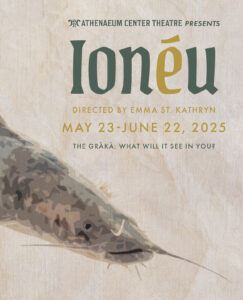
This month, the Athenaeum Center for Thought and Culture premieres Ionéu: A Retelling, a bold new neo-Greek tragedy by playwright Jacob D. Groth. Rooted in the ancient narrative of Jonah, the story is reimagined for contemporary audiences through poetic verse, elemental staging, and a soul-searching exploration of mercy and transformation. At the helm is director Emma St. Kathryn, whose deeply collaborative and spiritually resonant vision brings Groth’s mythic world to life.
Why This Story, Now?
St. Kathryn’s relationship with Ionéu began with a draft Groth shared in 2020—a version that immediately captivated her.
“Jacob D. Groth’s writing and his embrace of the theatrical form—that is, of a neo-Greek tragedy—gives this widely-known story a breath of new life,” she says. “I fell in love with the cadence of his free-verse and the emotional scope explored in what is often either a cutesy story or a message of severe warning.”
In our digital age, St. Kathryn sees Ionéu as an urgent opportunity to restore deep, empathic dialogue—something she feels has been eroded by the speed and superficiality of online communication.
“Jacob’s script invites us to have an honest dialogue with the person of Ioné (our Jonah figure, pronounced YO·nay) and, through that dialogue, reflect on our own internal process.”
A Full-Bodied Theatrical Journey
“There is dejected misery, exuberant joy, teeth-chattering fear, tantalizing intrigue, engulfing warmth, and isolating chilliness,” says St. Kathryn, regarding the range of emotions audiences can expect to feel watching Ionéu. “Theatrical form holds you gently as you sympathize with the characters… and find release through that age-old purgative experience of catharsis.”
Movement is central to the show’s storytelling. The ensemble uses their bodies to create over ten distinct landscapes, imbuing each moment with breath, individuality, and collective power.
“The ensemble moves, breathes, and emotes together… painting an organic and lively image with new, nuanced meaning every night.”
The music, composed by Groth and expanded by Music Director Sky Yela, functions as a character in its own right.
“The actors are moved by the music, inspired by its call to action, in harmony with the audience… It presents its own emotional argument; it is an undeniable, irrefutable presence.”
Building a World
Design plays a crucial role in grounding Groth’s imagined world of the Gànī clans. Drawing from global inspirations—Celtic, Asian, European, and biblical—Costume Designer Ashley Guinn establishes a visual language that evokes a lake-centered people. Scenic Designer Kevin Scott, Props Master Isa Pardilla, and Sound Designer Colin Kovarik extend this world into a fully immersive environment.
“While the particulars of this world are grounded in Groth’s creation, the universal themes are not only stirring for the individual but prescient for us as a people,” says St. Kathryn. “We explore the survivor’s guilt of one who outlives a people who are suddenly and brutally massacred. We walk through the pain of losing those near and dear to brutal, inhumane tragedy. We sit in the horror of a heart mutilated by unrelenting hatred, festering against a faceless people. And we ask the question: are we truly alone when we face this terror?”
Epic Scope, Intimate Collaboration
The production is both intimate and sweeping in scale, incorporating shadowplay, puppetry, chorus, song, and devised movement.
“My greatest challenge as director is likely my greatest joy,” St. Kathryn reflects. “All I have to do is point in a direction, listen to their offerings, and make the executive decisions that steer the ship toward theatrical wonders!”
Deep collaboration defines the project. From Intimacy Coordinator Madeline Meyer’s care in crafting emotionally safe practices, to playwright Groth’s generous insights on the fictional Gànī culture and language, the production thrives on mutual trust and shared purpose.
“The cast acts in tremendous courage each time they step into this story,” says St. Kathryn. “And Meyer has curated a safe environment for them to do so with trust that they will be held and protected from wounding.”
Inspirations and Legacy
St. Kathryn draws on diverse artistic influences, including Julie Taymor, Pina Bausch, and Lookingglass Theatre’s Moby Dick. Yet her roots remain close to home, grounded in her foundational training under Ballet 5:8’s Julianna Rubio Slager and actor-director Wayne S. Turney.
“All of my staging and movement styles will forever take direct influence from my primary tutors as a blossoming artist.”
An Invitation to Reflect
What does she hope audiences carry with them after the curtain falls?
“We, the artists, invite the audience to reflect on their own hearts and ask the question: ‘Am I clinging to hatred?’ We are all invited through this process to reflect on which experiences and memories from our past have been neglected, left to grow and distort, closing ourselves off to the compassion necessary to not only forgive but to also grow in love, peace, and joy—to live according to the Gospels.”
Ionéu: A Retelling makes its world premiere on May 23 at the Athenaeum Center for Thought and Culture, and runs through June 22. Tickets and more info available here.