“Strange, isn’t it? Funny, even. Intriguing. Yes—intriguing. That a man of such consequence, a prophet, should have tried so hard not to be one.”
This was the first line Jacob Daniel Groth wrote for Ionéu: A Retelling. That single sentence, half-musing, half-confession, set in motion a journey through mythology, language, and the human heart that would ultimately lead to a hauntingly lyrical stage work. A reimagining of the biblical Book of Jonah, Ionéu isn’t a simple adaptation—it’s an excavation. And what Groth unearths is both foreign and familiar, strange and painfully human. This bold new work makes its debut at Athenaeum Center for Thought and Culture as the final show in our inaugural 2024 – 2025 season. We sat down with Jacob to learn more about his process and discuss the lessons and mysteries within the story.
A Journey Through Jonah—and Beyond
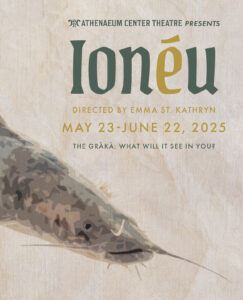
What first drew Groth to Jonah wasn’t just the story’s theological weight, but its layers. “Encounters with all manner of cultural, historical, linguistic, and symbolic details… is what initially piqued my interest,” he reflects. But it wasn’t until he imagined the narrative unfolding with a chorus-like band of storytellers—a nod to ancient Greek drama—that he saw the play take theatrical form.
This neo-Greek structure gave Groth the freedom to wander, and wander he did—not only geographically, but mythologically. Loàga, the fictional land in which Ionéu takes place, is Groth’s own mythopoeic invention, a place with its own gods, cultures, and creatures, most notably the Gràkà—a being who swallows Ioné, much like the great fish in the original tale. But the Gràkà is no simple metaphor.
“Jonah’s rejection of GOD’s calling is what led to his being swallowed up, but it was precisely this being swallowed that brought him exactly where he was supposed to be,” Groth says. “A dual nature is at play.” And it’s this kind of paradox—fate disguised as failure, mercy disguised as monster—that recurs throughout Ionéu.
Wrestling With Resentment
Beneath the fantastical language and crafted myth lies something deeply personal. Groth describes one of the central questions he wrestled with while writing: “How is it possible that I could be so decidedly resentful of another that I’d rather suffer misery myself than allow them to experience joy?”
This question cuts to the core of the Jonah narrative. It’s not just about divine calling or disobedience—it’s about the scandal of mercy: that someone else could be forgiven, blessed, or loved in the same way as oneself—even when it seems they don’t deserve it. Ionéu doesn’t resolve that tension; it lets it breathe.
“Mercy is active,” Groth says. “It intervenes. It takes on suffering.” But that act of intervention often disturbs before it heals. It’s what makes Ionéu less a sermon and more a mirror, reflecting our resistance to grace.
Language as Landscape
Groth’s writing style is almost liturgical in tone—poetic, elevated, and full of surprising juxtapositions. But it’s not flowery for its own sake. It’s a craft. “There’s a lot of speaking aloud in the ‘voice’ of the characters,” he explains. From there, it becomes a meticulous layering process: identifying the emotional truth, consulting a thesaurus, refining sound and rhythm, and finally, selecting the precise word that “feels organically ornate.”
The result is dialogue that reads like incantation—meant to be heard, felt, and contemplated.
Building a World to Ask Bigger Questions
Earlier drafts of Ionéu stayed close to the biblical text. But over time, Groth discovered the story’s fullest expression not in ancient Nineveh, but in a fictional land of his own making. “It was more a discovery than an invention,” he says. “Only when choosing to follow each new discovery was I able to express what I encountered within the story.”
The world-building isn’t just aesthetic—it’s thematic. Loàga allows Groth to explore truths without the constraints of historical realism. Greek tragedies, biblical symbolism, Lewis’ Till We Have Faces, and hidden linguistic clues all contribute to a textured tapestry that feels ancient yet new.
A Play That Questions, Not Preaches
At the heart of Ionéu is a quiet ambition: to leave audiences not with answers, but with questions.
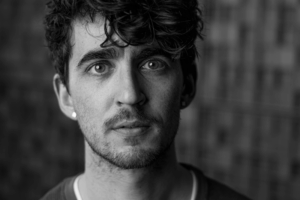
Groth isn’t interested in didacticism. He wants contemplation. Ionéu isn’t a roadmap—it’s a riddle.
“I just hope people walk out feeling they’ve been asked questions,” he says. In a cultural moment where clarity often masquerades as virtue, Ionéu invites us to sit with the uncomfortable. To witness a prophet who would rather run than forgive. A monster who becomes a vehicle of grace. A world that looks nothing like ours and yet knows us intimately.
Strange, isn’t it?
—
Hear the call and witness the world-premiere of Ionéu at Athenaeum Center in Chicago this Summer, from May 23 – June 22. A new journey awaits.