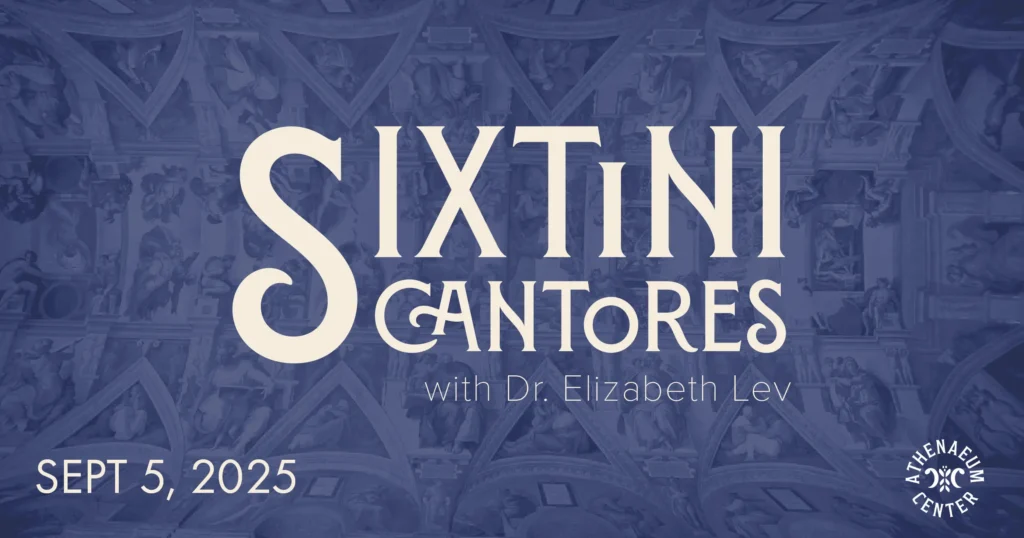
On Friday, September 5, 2025, Athenaeum Center for Thought and Culture will present an extraordinary evening that brings together music, history, and faith. Sixtini Cantores, featuring members of the Sistine Chapel Choir, will perform a concert of sacred polyphony. The program will be enriched by a presentation from renowned art historian Dr. Elizabeth Lev, offering insights into the artistic and spiritual meaning of the Sistine Chapel.
This event is more than a concert: it is a rare opportunity to encounter beauty shaped by centuries of tradition, brought to Chicago for one night only. Tickets are available now, and advance purchase is strongly encouraged. Read on the history of the Pope’s personal choir as you prepare for the Sistine Chapel Choir concert in Chicago.

The Origins of the Papal Schola Cantorum
The Church has turned to music as a form of worship since its earliest days. After emerging from the catacombs, sacred song began to flourish in its beauty and splendor. As early as the pontificate of Sylvester I (314–335), a formally established group of singers, known as the schola cantorum, lived together in a dedicated building. The term schola at that time referred to a guild-like association, a character that defined the papal choir for centuries.
Pope Gregory the Great (590–604) permanently established the papal schola cantorum at St. John Lateran and later at St. Peter’s Basilica. This became the foundation of Catholic sacred music, eventually spreading across Europe and shaping the Church’s musical tradition.
For centuries the papal schola preserved and refined this heritage, led by the archicantor or primicerius, often a high-ranking clergyman.
From Avignon to the Sistine Chapel
A new chapter began in the 14th century when the papacy moved to Avignon. Clement V (1305–1314) formed a choir there, composed largely of French singers, while the ancient schola cantorum continued in Rome. When Gregory XI returned the papacy to Rome in 1377, the choirs merged, creating a stronger, more diverse body of singers.
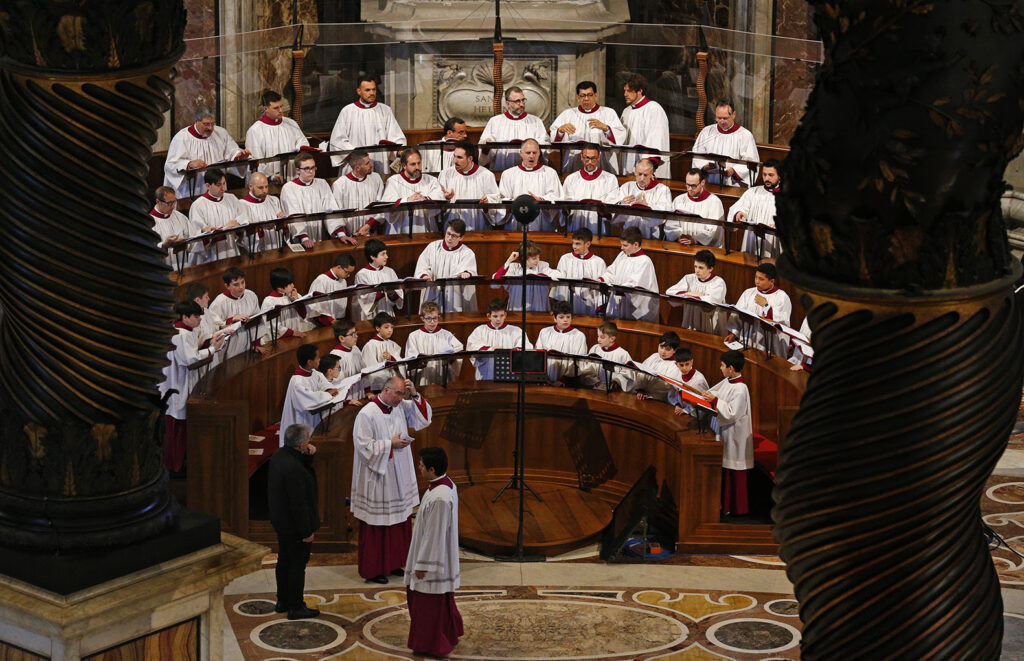
This reorganization prepared the way for the true golden age of papal music. When Sixtus IV (1471–1484) built the Sistine Chapel, the choir attached to it became the Capella Sistina, or Sistine Chapel Choir. In 1483, Sixtus IV fixed the number of singers at twenty-four, with six for each part. From that point forward, the Sistine Chapel Choir became the standard for Catholic liturgical music, admired across Europe.
Membership in the choir was highly coveted, attracting the greatest singers and composers of the period. To nurture future generations, Julius II founded the Capella Julia in 1512, which continues today as a preparatory choir for St. Peter’s Basilica.
A Global Standard of Sacred Music
The Sistine Chapel Choir distinguished itself through artistic excellence and fidelity to the liturgy. Its music was consistently performed in a purely vocal style, excluding instruments, even the organ. This a cappella tradition underscored the choir’s devotion to the sacredness of worship.
The choir gave the world the music of Giovanni Pierluigi da Palestrina (1525–1594), whose Missa Papae Marcelli shaped the reforms of the Council of Trent by preserving the clarity of sacred texts while elevating them in polyphonic beauty. Later, figures such as Abbate Giuseppe Baini (1775–1844) continued to protect and renew the tradition, ensuring its survival into the modern age.
Today the Sistine Chapel Choir remains dedicated to papal liturgical functions, offering its voice in prayer and worship and serving as a guardian of Catholic sacred music.
Sixtini Cantores: Continuing the Legacy
Sixtini Cantores represents the continuation of this centuries-old tradition. Composed of members of the Sistine Chapel Choir, the ensemble brings the sound of Rome’s most revered choir to audiences around the world. Their performances are not simply concerts, but liturgical encounters that preserve the purpose of sacred song: to elevate the soul and serve the worship of God.
For audiences in Chicago, this performance will be an opportunity to experience the sound of the Vatican’s sacred heritage in a setting that connects history, faith, and art.
Dr. Elizabeth Lev: Illuminating the Sistine Chapel
Complementing the music will be a presentation by Dr. Elizabeth Lev, one of today’s most engaging Catholic art historians. Based in Rome, Dr. Lev has written extensively on Renaissance art and frequently speaks on the cultural treasures of the Church. Her lecture will explore the meaning of the Sistine Chapel and its place in Catholic tradition, providing historical and spiritual context that deepens the musical experience.
A Night Not to Be Missed
The legacy of the Sistine Chapel Choir continues through Sixtini Cantores, and for one evening, Chicago audiences will have the chance to hear it in person. With the scholarship of Dr. Elizabeth Lev adding depth and insight, this event offers a unique combination of beauty, history, and faith.
Join us at Athenaeum Center for Thought and Culture on September 5, 2025, for a night that bridges centuries of tradition and invites you into the enduring mission of sacred song.
Event Details
Friday, September 5, 2025
Doors: 7:00 PM | Show: 8:00 PM
Athenaeum Center for Thought and Culture
2936 N Southport Ave, Chicago, IL 60657
Reserve your seats now for an evening of sacred music and Catholic cultural heritage.