Today, Athenaeum Center is a home for theatre, music, dance, conversation, community events, and original artistic work on Chicago’s North Side. Its story reaches back to the St. Alphonsus Athenaeum, the parish-rooted cultural space whose early life appears again and again in the Chicago Tribune archives.
Across the Historic Main Stage, the Paradiso Ballroom, black box studios, rehearsal rooms, and gathering spaces, the building continues to welcome artists, audiences, speakers, neighbors, schools, parishes, nonprofits, and civic groups.
But that work did not begin with the name Athenaeum Center.
Long before generations of Chicago artists knew it as the Athenaeum Theatre, the building at Southport, Lincoln, and Wellington was already serving a cultural purpose. Its roots reach back to the St. Alphonsus Athenaeum, the parish-rooted cultural space whose early life appears again and again in the Chicago Tribune archives.
A century of history is rarely preserved in one perfect record. More often, it survives in fragments: a cast photo, a performance notice, a rehearsal image, a newspaper clipping tucked away from another era.
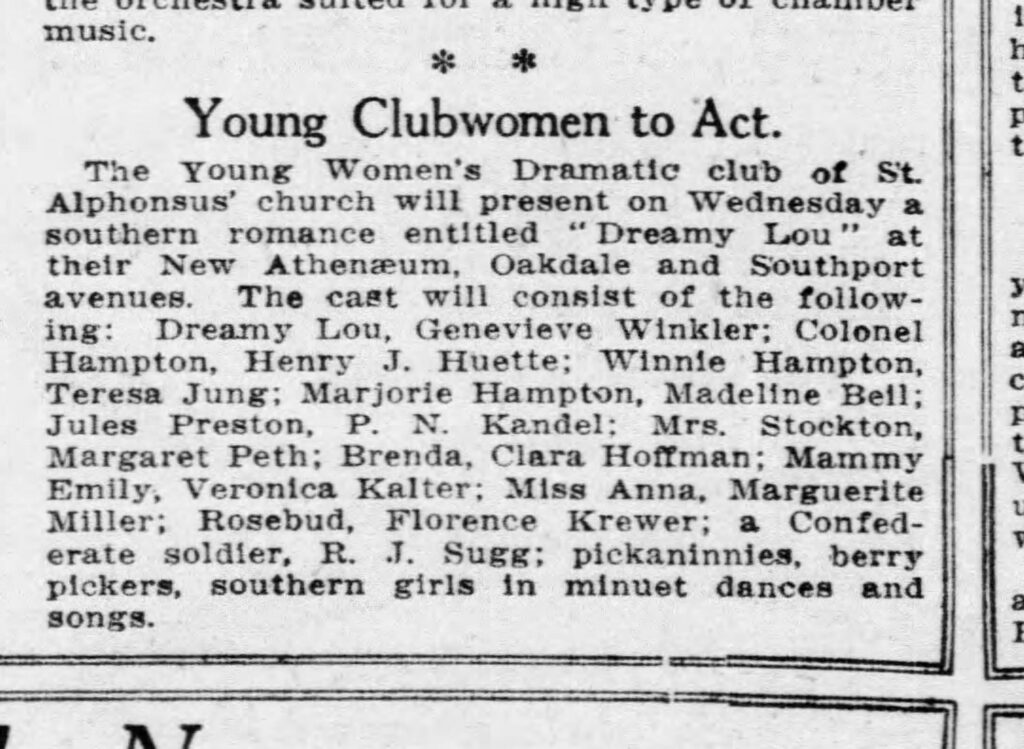
One of those fragments appeared in the Chicago Tribune in 1912, under the headline “Young Clubwomen to Act.” The notice announced that the Young Women’s Dramatic Club of St. Alphonsus Church would present a play at their “New Athenaeum” at Oakdale and Southport avenues.
Only a year after the Athenaeum’s 1911 beginnings, the building was already alive with performance.
Rooted in the St. Alphonsus Athenaeum
The archive does not tell the whole story. But in the pages of the Tribune, the Athenaeum appears again and again under different names: the “New Athenaeum,” the St. Alphonsus Athenaeum, the Athenaeum Theatre. The details change from decade to decade, but the pattern is remarkably steady.
For more than a century, this building has gathered Chicago around theatre, music, dance, education, community, and beauty.
Parish, School, and Neighborhood Stages
The next decades fill in the picture.
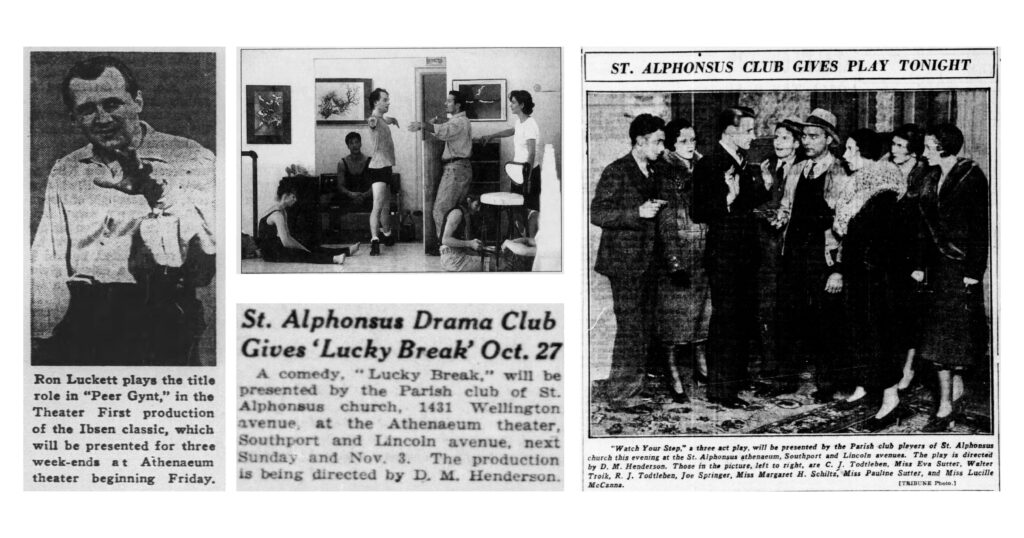
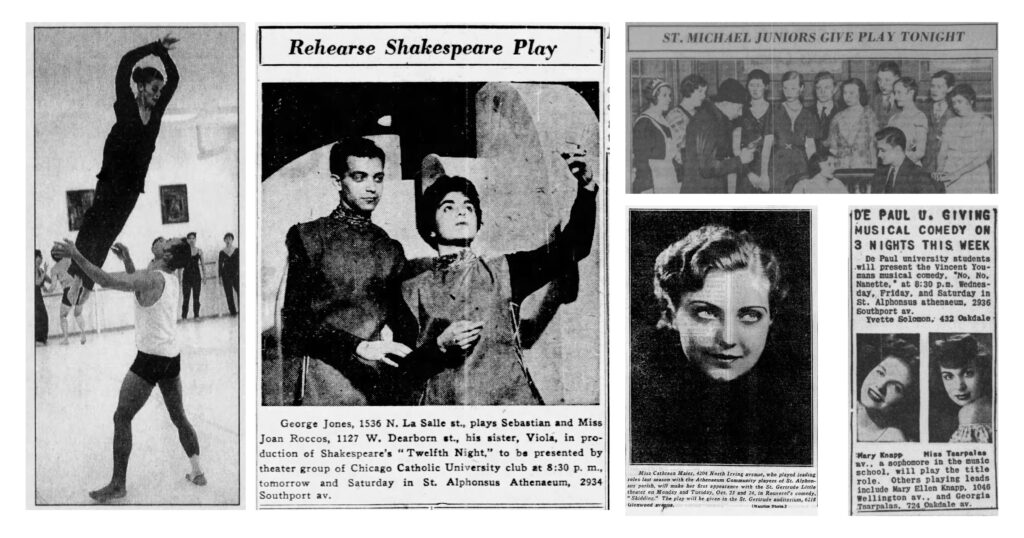
In 1917, the Tribune reported that students from the high school of the Convent of the Holy Child Jesus would give an operetta at the Athenaeum, under the direction of a Loyola University professor. In 1920, the Edgewater Catholic Woman’s Club auxiliary appeared at St. Alphonsus Athenaeum for a dramatic presentation. By the late 1920s and early 1930s, the St. Alphonsus Drama Club and parish club players were regularly connected to performances at the Athenaeum.
A 1931 Chicago Sunday Tribune photo captures that world vividly. Under the headline “St. Alphonsus Club Gives Play Tonight,” parish club players appear in costume for Watch Your Step, a three-act play presented at the St. Alphonsus Athenaeum at Southport and Lincoln avenues.
A few years later, another clipping refers to the Athenaeum Community Players of St. Alphonsus parish. The phrase says a great deal. It connects parish life, neighborhood life, and theatre in one place.
The Athenaeum was not simply hosting occasional events. It was helping form a culture of participation.
A Catholic Cultural Commons
By the middle of the 20th century, the archive shows the Athenaeum serving a wider Catholic cultural network.
DePaul University students staged musical theatre at St. Alphonsus Athenaeum in the late 1940s. The Quincy College Chorus, a 60-voice ensemble touring through the Midwest, gave a concert there in 1950. In 1957, a Tribune photo showed performers rehearsing Shakespeare’s Twelfth Night, presented by a theatre group of the Chicago Catholic University Club.
The range is striking: operetta, musical comedy, choral music, Shakespeare, parish drama, student performance, and community theatre.
Seen through its Catholic roots, this range of activity is more than a list of entertainments. It reflects a tradition in which culture is not treated as ornamental or secondary. Beauty, in the Catholic imagination, is bound to truth, goodness, meaning, and the dignity of the human person.
The Athenaeum Theatre Emerges
By the 1960s, the clippings begin to sound more familiar to modern readers.
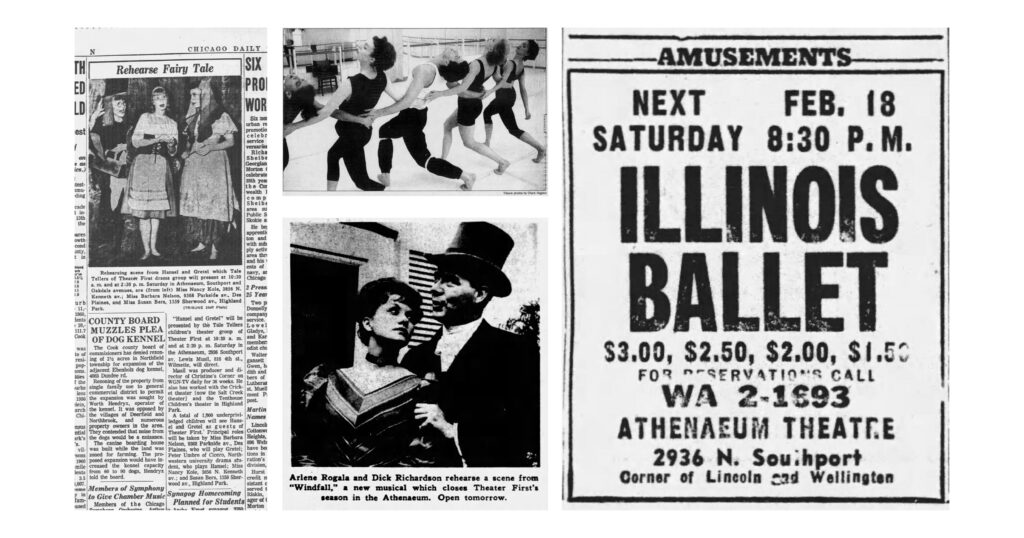
A 1961 advertisement lists the Illinois Ballet at the Athenaeum Theatre, 2936 N. Southport. In 1962, a Chicago Daily Tribune photo shows performers rehearsing Hansel and Gretel, presented by the Tale Tellers children’s theatre group of Theater First at the Athenaeum. The article notes that 1,000 underprivileged children would see the production as guests of Theater First.
In 1964, another clipping captures a rehearsal scene from Windfall, a new musical closing Theater First’s season “in the Athenaeum.” In 1967, the Athenaeum Theatre appears again as the home of Theater First’s production of Peer Gynt.
The public name was shifting. The building that earlier appeared as the St. Alphonsus Athenaeum was now increasingly visible as the Athenaeum Theatre.
But the deeper pattern continued. Artists rehearsed. Audiences gathered. Young people encountered live performance. The stage stayed alive.
A Home for Independent Chicago
Later Tribune clippings place the Athenaeum within another important chapter of Chicago cultural life: independent theatre, dance, smaller companies, and Off-Loop performance.
A 1990 article, “Athenaeum Theatre troupe remains faithful to classics,” describes a North Side theatre environment rooted in commitment, resourcefulness, and classic works. In 1995, the Athenaeum appears as part of Dance ’95, a project spotlighting Chicago’s smaller dance companies. In the early 2000s, Tribune coverage connected the Athenaeum to fringe-style performance and ambitious small-company productions.
Chicago’s arts ecosystem has always depended on places that make room: room for rehearsal, room for experiment, room for smaller companies, room for artists still forming their voices.
For many of those artists and audiences, the Athenaeum was one of those places.
A Building with Memory
A clipping is not the whole story. It is only a fragment: a headline, a cast photo, a performance notice, a review, an advertisement, a date.
But clipping after clipping, decade after decade, reveals a pattern.
People have been coming to this building for more than a century: to rehearse, to sing, to dance, to study, to perform, to listen, to gather.
That is why the history of Athenaeum Center matters. The building is not only old. It carries memory. Its walls have held parish plays, Catholic school operettas, women’s dramatic clubs, university musicals, choral concerts, Shakespeare, ballet, children’s theatre, community theatre, fringe performance, dance, and new work.
Today, Athenaeum Center continues that long story through the restoration and renewal of a historic Catholic arts space. Its mission is a continuation of something already visible in the archive: a belief that places matter, that beauty gathers people, and that a building rooted in Catholic cultural life can continue to serve the life of the city.
Since 1911, the Athenaeum has been a place where Chicago comes together.