On Friday, May 8, Start at the End: An Evening of Music by Ellis Ludwig-Leone comes to Athenaeum Center, bringing together Eighth Blackbird and San Fermin for a performance that moves between concert music and contemporary songwriting. Part of the Beauty from Brokenness series, the program reflects on how music can transform loss into connection, and endings into new beginnings.
At the center of the evening is composer and songwriter Ellis Ludwig-Leone, whose work has long bridged classical composition and indie rock. With Start at the End, that relationship becomes the structure of the performance itself: a first half of instrumental works written for Eighth Blackbird, followed by a second half that expands into song, as members of San Fermin join the ensemble for newly arranged material. In this program, Start at the End moves between composition and songwriting, building toward a shared musical language. The Start at the End Chicago performance reflects that balance throughout the evening.
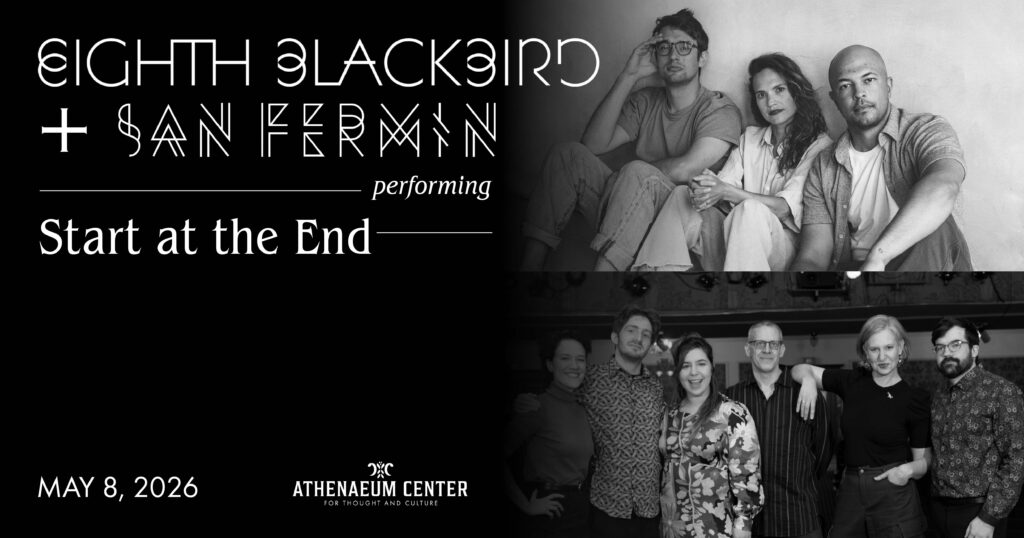
We caught up with Ludwig-Leone ahead of this program at Athenaeum Center. In our conversation, he reflects on collaboration, revisiting past work through new arrangements, and how themes of loss and transformation emerge naturally through the creative process. He also shares what surprised him most about working with Eighth Blackbird and what audiences might not expect from this genre-crossing performance. The Start at the End performance in Chicago brings that collaboration into focus through both structure and improvisation.
Start at the End: An Evening of Music by Ellis Ludwig-Leone
featuring performances by Eighth Blackbird and San Fermin
5/8/26 | Doors: 7:30 PM | Show: 8:00 PM
Athenaeum Center for Thought & Culture, Paradiso
2936 N Southport Avenue, Chicago, IL 60657 · Free Parking
Get Tickets
ACTC: How would you describe Start at the End, and what can audiences expect from its first performance?
Ellis Ludwig-Leone: his is a really special performance in that it’s a coming-together of two musical worlds, classical and pop. The first half of the concert will be instrumental concert music I have written for the legendary Chicago-based ensemble Eighth Blackbird. For the second half of the concert, Allen and Claire from my band San Fermin will join us for a set of San Fermin songs, with brand new arrangements I have made for Eighth Blackbird.
ACTC: How did this collaboration with Eighth Blackbird begin, and what first sparked the idea for this program?
EL-L: I met Lisa (Eighth Blackbird pianist) years ago through our mutual friend Nico Muhly. We stayed in touch and then when I was in town to play Thalia Hall last year, she invited me to come meet Emily Anderson (Artist Booking Agent) and see the Athenaeum. We just clicked and got talking about ways we could work together.
ACTC: The title suggests beginning with an ending. What drew you to that idea?
EL-L: Emily had mentioned that the theme for this year’s programming was “beauty from brokenness.” I was just coming from a tour in which we were playing songs from a breakup album I had written the year before, so I was already thinking about similar themes: how to move on from loss, and how to use that experience to grow.
ACTC: The evening grows from a solo piano piece into a full collaboration between the ensemble and the band. How did you shape that journey for the audience?
EL-L: Community is the best resource we have when it comes to finding our way through difficult times. I thought it could be a cool idea to lean into that, to literally show a group coming together over the course of an evening.
ACTC: Your work often sits between classical composition and indie songwriting. Do those feel like different languages to you, or part of the same conversation?
EL-L: They’re like different dialects of the same language. I think of composing like being an architect, designing a house that people can live in. Songwriting is more like inviting someone into your living room for a drink.
ACTC: You wrote Arms during a period of personal upheaval. What has it been like to revisit that material in this new context?
EL-L: Once the songs are finished and out in the world, they stop being yours. I’m proud of these songs, but at this point, they have their own lives. But it’s fun to dress them in this different arrangement, especially because some of them were fairly sparse in their original versions. This gives me more of a chance to lean into the nuts and bolts of how the songs are actually structured, and emphasize those aspects with a new arrangement.
ACTC: This program has a thread about transformation and finding meaning through loss. Is that something you set out to explore, or something that revealed itself over time?
EL-L: I don’t really set out to explore a theme. I think if you’re doing your job as an artist, you just follow the thread of whatever you’re interested in, or fixated on, or scared of, and then naturally certain themes will start to present themselves. In this particular case, it’s like, “okay, here’s a loss, I feel bad, now what?” Naturally you’re going to try to answer that next question.
ACTC: This performance also features a world premiere. What can you share about that piece, and what made this collaboration the right place for it?
EL-L: The new piece is called Family Machine, and it was commissioned specifically for this concert.
Recently I noticed I have been writing a lot of hyperactive pieces, with a feeling of constant churning motion. I started wondering, where is that restlessness coming from? Then around the holidays, my friend Emma Healey, who is a poet, texted me something about “being put through the family machine.” It stuck with me, the idea of Family as the ultimate perpetual motion machine: a unit that exists to perpetuate itself.
I thought it would be fun to try to musicalize this concept, and Eighth Blackbird is a perfect partner for that, because they’re like the masters of really rhythmic, grooving music. I grew up listening to Eighth Blackbird, so to write a new piece for them is quite special.
ACTC: What has surprised you most in working with Eighth Blackbird on this project?
EL-L: They’re so chill! Sometimes working with ensembles can be stressful because there’s this whole negotiation of like, “this is a collaboration” but if it’s a short timeline it can feel like “here’s the sheet music go learn it okay bye.” And I hate that part, I really want every musical experience to feel like a collaboration. Eighth Blackbird is great at that—they’re super open to ideas and they’ve just been around long enough and have been so successful doing their thing that they’re super open to new experiences.
ACTC: For someone encountering your work for the first time that night, what do you hope stays with them afterward?
EL-L: Even though there are some heavy themes especially in the songs, I hope the main takeaway is joy. Music has this amazing ability to transform bad feelings into good ones. That’s what this concert is about. And then if they come away enjoying a genre of music they might not have encountered before, that’s even better.
ACTC: What is something about this show that audiences might not expect? How do you think it connect to your career trajectory to date?
EL-L: For a classical ensemble, Eighth Blackbird grooves so hard. And for a band, San Fermin can execute some really high level musical things. So there’s an artistic exchange happening across genre lines right there in front of everyone that I think will be pretty unusual. And because all the music started with me, having written it, hopefully the center of that Venn diagram will be really accessible and inviting to the audience.
About Start at the End: An Evening of Music by Ellis Ludwig-Leone
Start at the End Chicago is part of Athenaeum Center’s Beauty from Brokenness series, which explores how art, faith, and the human spirit transform suffering into something restorative and communal. In this program, that idea unfolds musically, beginning with a solo piano work and gradually expanding into a full collaboration between ensemble and band.
As the evening progresses, the performance grows from something intimate into something collective, reflecting the core idea behind the program: that meaning is not found in isolation, but built through shared experience.
By bringing together Eighth Blackbird and San Fermin, the program moves beyond genre distinctions in favor of storytelling and connection. What emerges is not a linear arc, but a cycle: an ending that becomes momentum, a farewell that becomes the beginning of something new.